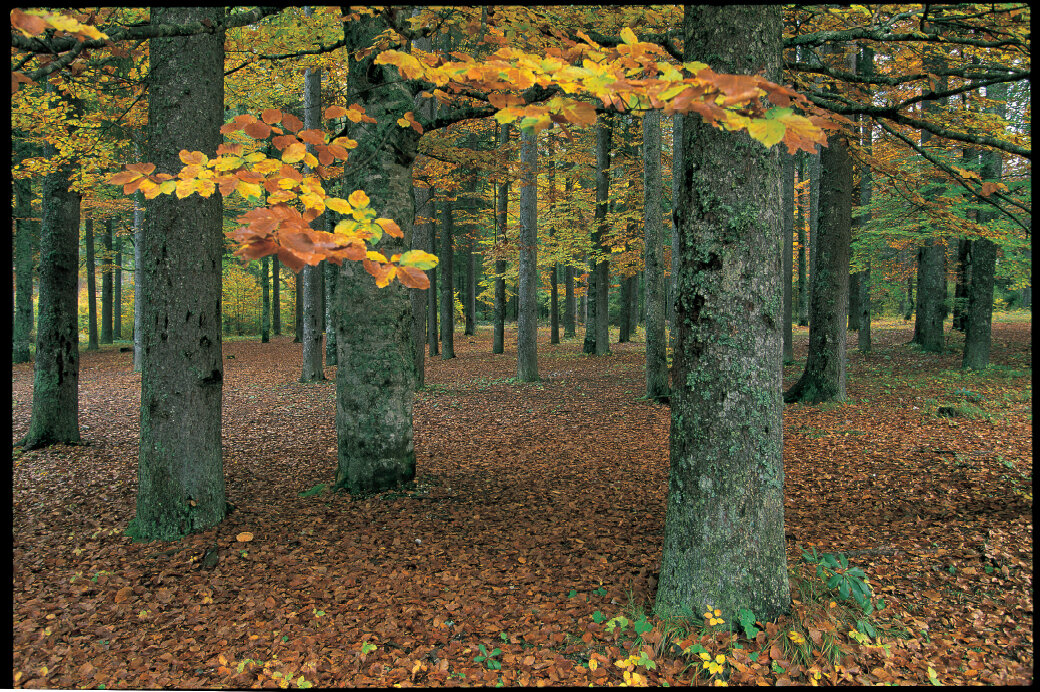
THE MILLENNIAL FOREST OF TARVISIO
In 1007 the German Emperor Henry II the Holy gave the territory of the Tarvisio Forest to the Bishopric of Bamberg in Bavaria. The ecclesiastical principality of Bamberg would last seven and a half centuries, until 1759 when it was purchased by Maria Theresa Empress of Austria. During that period, so-called "rights of servitude," almost free grants of grazing, timbering, etc., by the feudal lord to the local people to ensure their subsistence, came into being. After the Bamberg period followed a troubled cycle of invasions and wars, culminating in the Napoleonic battles. During the 1800s the Forest passed into the ownership of numerous nobles until the Austrian government, concerned about the heavy deforestation resulting from the frequent changes of ownership and motivated by the need to ensure social tranquility in a militarily important border area, bought back the land and entrusted its management to state forestry technicians. At the end of the First Conflict of 1915-18, under the Peace Treaty of San Germano in the year 1919, the Forest passed to Italy and was entrusted to the State Property of the Italian State. Under the Lateran Accords, the assets of the former Austrian religious funds were united with the Italian economic assets to form a company administered by the Fund for Worship, now dependent on the Ministry of the Interior. With the revision of the Lateran Pacts in 1985, the present Worship Buildings Fund was established to administer all former ecclesiastical properties that had come to the Italian state.
24,000 HECTARES OF ALPINE AREA, 15,000 OF WHICH ARE COVERED WITH PRODUCTIVE FORESTS
Crossed by the Fella River, it extends to the border with Austria and Slovenia, along the entire Valcanale and Slizza valleys affecting the municipalities of Pontebba, Malborghetto-Valbruna and Tarvisio. It encompasses numerous valleys south and north of the mentioned watercourse, such as the Rio Bianco and Malborghetto valleys, Ugovizza, Valbruna, Bartolo canal and Rio del Lago valley. It represents one of the most valuable naturalistic areas in Italy and one of the most complete wildlife systems in the Alps. The "naturalness" of the forest's vegetation cover, in fact, is demonstrated by the richness of the wildlife present, especially with regard to ungulates and tetraonidae. Of great importance is also the sporadic presence of bears and lynx.
It has been declared a "Biogenetic Oriented Nature Reserve." The ownership of these woods is from the Worship Buildings Fund of the Ministry of the Interior and is managed by the Ministry of Agriculture and partly by the Friuli Venezia Giulia Regional Forestry Company.
Cutting of the forests (15,000 cubic meters per year satisfies centuries-old customs of the timber servitudes of entitled valley dwellers) is regulated by special plans: naturalistic forestry techniques are strictly observed, involving moderate and scalar cuts so as to maintain a continuous and similar tree cover.
Timber from the Tarvisio area is particularly prized for its use in technology; a quality of spruce (called resonance spruce) is prized and used in the manufacture of musical instruments.
RESONANCE FIR
Resonance spruce is similar in external appearance to other "normal" spruces, and only the eye of an expert can recognize it. However, certainty comes only with cutting and debarking, when the typical "V-shaped" introflections forming grooves 3-10 cm long and 2-3 mm deep irregularly arranged in the trunk are found. This structure makes the wood more elastic, improving its acoustic characteristics and in particular sound propagation.
Its presence is not widespread, but concentrated in a few areas of the Alps including the Valcanale and particularly the Fusine basin.
Resonance spruce is therefore a highly prized wood sought after by luthiers for making violins and other stringed instruments.
Since the distribution of this "singing tree" is limited to a few European areas, it can be assumed that several musical instruments, including those of distinguished luthiers of past centuries, were made from the resonance wood.


Point of arrival
The Tarvisio tourist destination is located in Friuli Venezia Giulia, on the border with Austria and Slovenia
