The Ancient Beech Tree
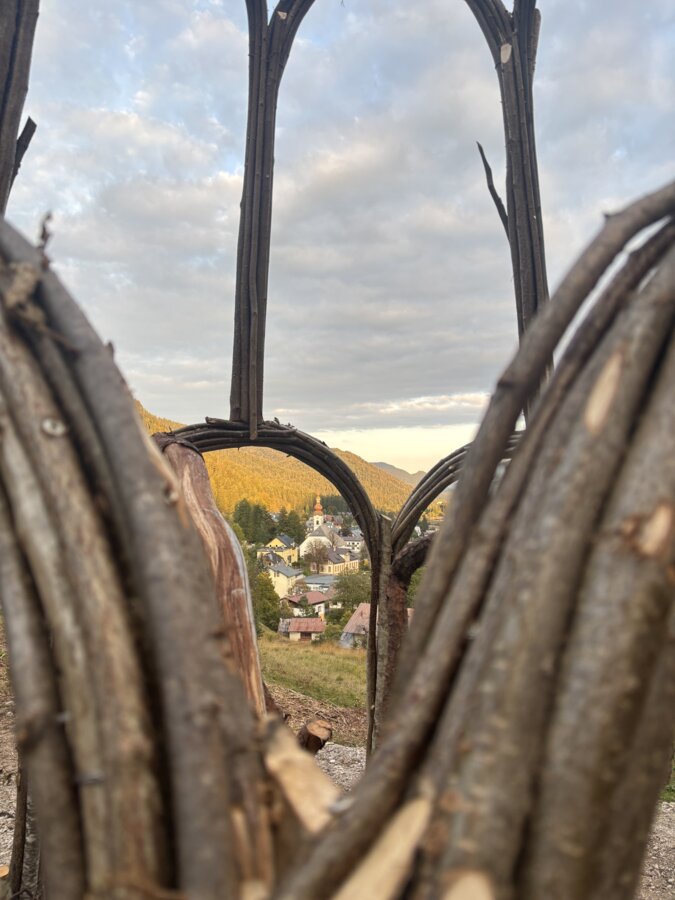
For over two centuries, this majestic beech tree
accompanied the journeys of locals, woodcutters,
pilgrims, and hikers.
Today, only its stump remains—a testament
to the forest's natural cycle.
A fallen tree does not cease to live:
its wood becomes a haven for insects,
fungi, and small animals; it enriches the soil
and fosters the growth of new plants.
Regeneration is nature's secret.
Bruno tells the story...
Nothing in the forest goes to waste.
Even what seems to have reached its end
continues to give life.

Land art installations along the route
FALLEN (Stefano Devoti)
The root of a fallen tree found along the path is preserved here to celebrate a silent,
invisible process: thousands of hectoliters of water transformed into matter, nourishment,
and oxygen for the benefit of the ecosystem, the landscape, and the community.
Young hazel trees intertwine to create a space that connects birth, growth, death,
decomposition, and regeneration—the very phases of life for which the forest serves
as a vivid stage.
nest (Devid Strussiat)
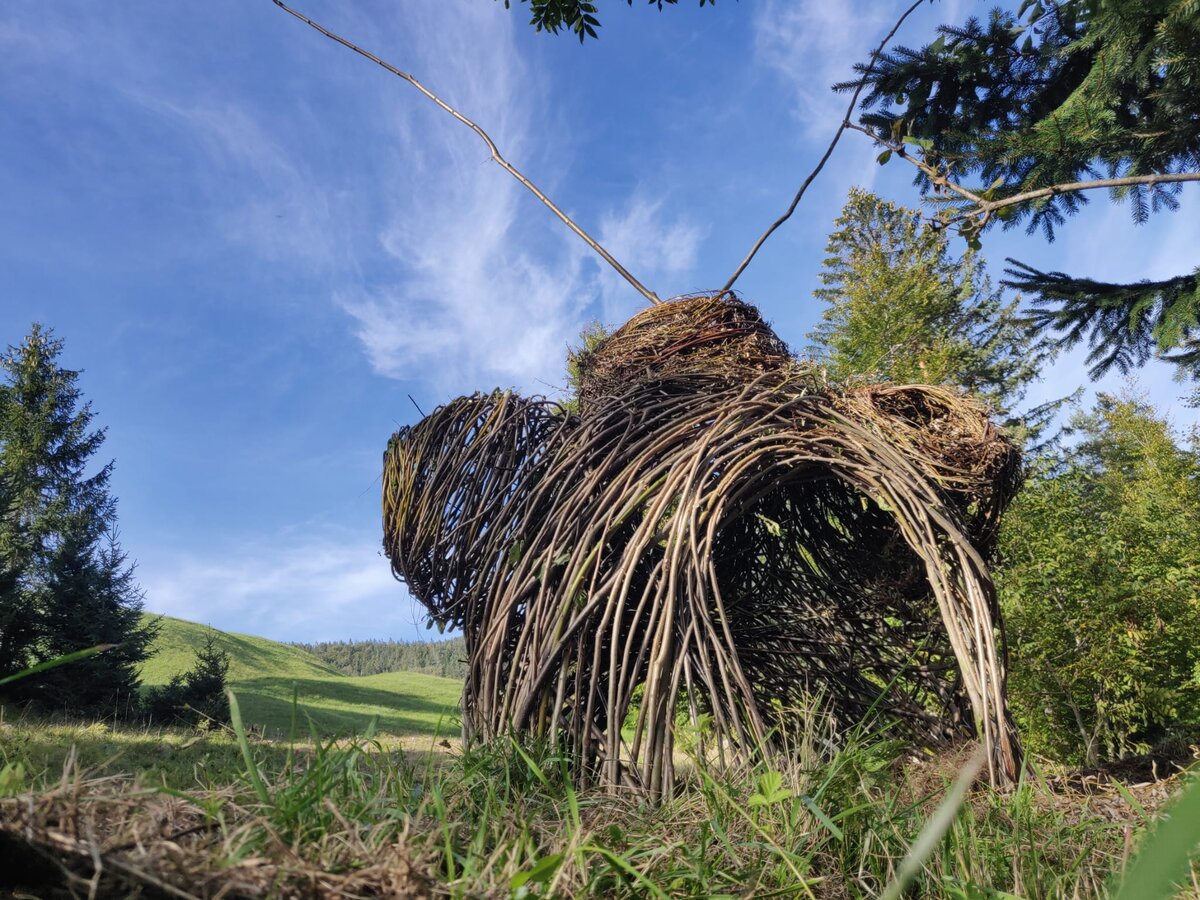
The work stems from the idea of transforming the concept of a den or shelter into an organic, fantastical form—one capable of inhabiting the landscape while simultaneously being inhabited itself.
Characterized by soft, rounded volumes, the form loosely echoes Paleolithic female figures—such as the Venus of Willendorf—evoking an archaic realm associated with protection, nurturing, and generation.
Openings and cavities serve as entry points to the interior, inviting visitors to step inside, linger, and play. Thus, the piece can become a den, a hiding place, or a small house—especially in the eyes of children.
The structure is crafted by weaving willow and hazel branches; these natural materials lend the form an organic, permeable quality that engages in a dialogue with the surrounding landscape. A lightweight internal iron framework ensures stability without detracting from the visual appeal of the woven texture.
The work thus sits at the intersection of sculpture, shelter, and play, fostering a direct, imaginative encounter between nature, the human body, and the landscape.
The Threshold of Time (Simone Paulin)
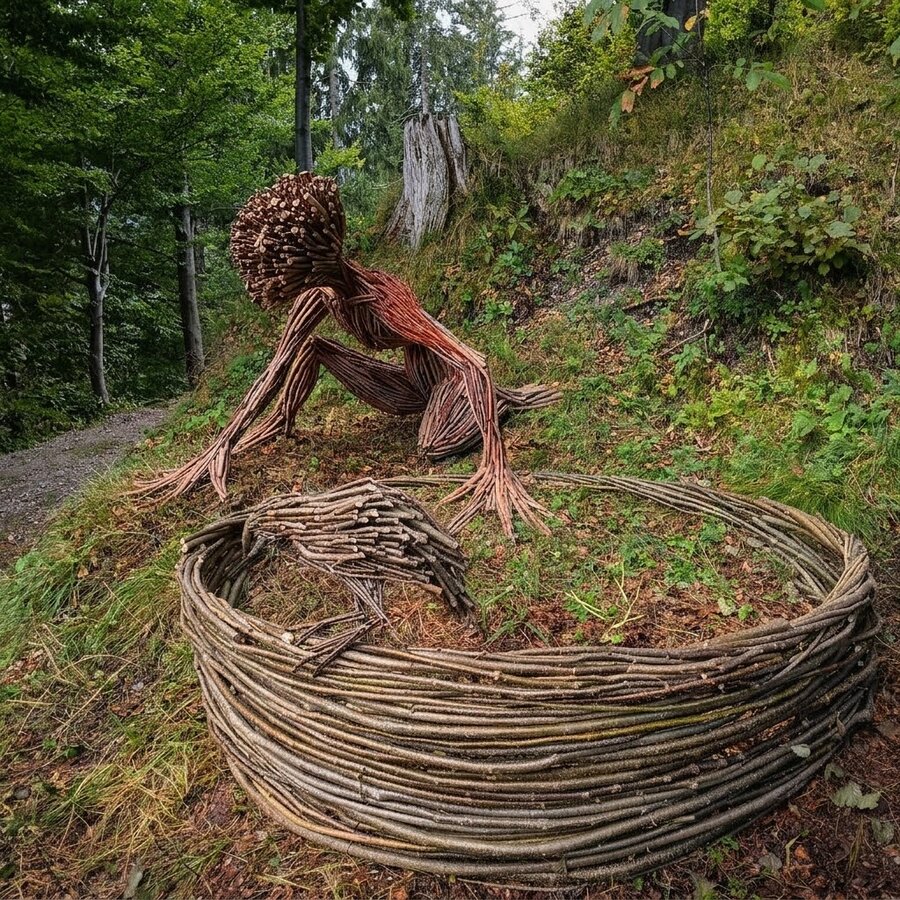
The wayfarer is one who seeks meaning, trapped within a linear perception of time.
The Raven is the guardian of knowledge and passage. It is a liminal creature, capable of
flying between the two worlds.
The Circle represents wholeness and eternity. It symbolizes the cycle of life,
renewal, and eternal return—devoid of beginning or end.
Ideally, it is man who walks along the outer edge of a circle, believing he is
moving in a straight line toward the future, while the raven—from the outside—can observe
man’s entire path: past, present, and future all at once.
The raven does not judge man’s journey, but preserves the memory of it.
The Circle represents Eternity and the Unconscious; Man represents the limited mind;
the Raven represents the Intuition that connects the finite to the infinite,
waiting for man to find the courage to look at it.
In this scene, the roles are reversed. What might happen?